

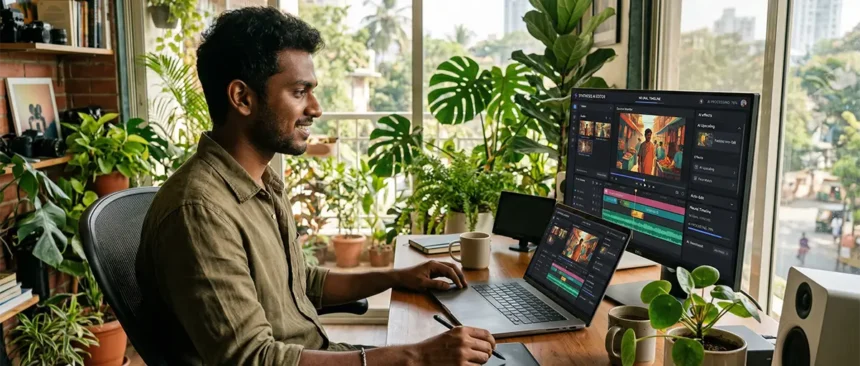
In 2026, the best AI tools for productivity allow Indian creators to bridge the gap between ideation and professional execution for zero cost. By leveraging multimodal models like Gemini 3 Flash, the sovereign AI ecosystem of Sarvam, and open-source video engines, “Budget-First” creatives can now produce high-fidelity content that previously required a ₹1.5 Lakh monthly overhead.
The 2026 Shift: Why Free AI Tools are Now Production-Ready
The primary shift in 2026 is the “Commoditization of Intelligence,” where high-tier reasoning and creative generation are no longer locked behind $20 monthly paywalls for basic users. As the digital landscape in India evolves toward a mobile-first, AI-integrated economy, the barrier to entry for high-quality content production has effectively vanished. According to recent industry benchmarks from DataCamp, the gap between “Pro” and “Free” tiers has narrowed by 60% compared to 2024, specifically in text-to-video and complex coding tasks.
The Rise of Multi-Agent Free Tiers
In previous years, free users were limited to single-prompt interactions. In 2026, tools like Google Gemini 3 Flash allow for multi-agent workflows where one AI researches while another drafts, all within the free ecosystem. This is particularly vital for Indian creators who need to balance regional context with global quality standards. Platforms like Claude 4.6 Sonnet have also introduced “Artifacts,” allowing creators to build simple web apps or interactive graphics for free, directly within the chat interface.
Sovereign AI and Localized Dominance
A significant factor for the Indian “Budget-First” Creative is the rise of “Make in India” models. Tools like Anuvadini AI and Sarvam AI have democratized high-end translation and dubbing. These tools are trained on indigenous datasets, ensuring that metaphors, slang, and cultural nuances in 22+ Indian languages are preserved—a feat that global giants often struggle with even in their paid tiers.
Technical Architecture: How These Tools Work for You
The underlying architecture of 2026 AI tools relies on “Small Language Models” (SLMs) and “Edge Processing,” which provide lightning-fast responses on mid-range smartphones without requiring high-bandwidth connections.
To maximize your output, you must understand the interplay between Large Language Models (LLMs) and specialized creative engines. As detailed by Google Cloud, the 2026 stack utilizes “Mixture of Experts” (MoE) architectures, which route your specific creative request to a sub-model optimized for that exact task, whether it’s vector illustration or spreadsheet automation.
Understanding Latency and Token Efficiency
For the Indian creator working on 4G or entry-level 5G, token efficiency is the new currency. The best AI tools 2026 now use advanced quantization and compression techniques. This ensures that a complex prompt—such as “generate a 30-second reel script in Marathi about sustainable fashion”—is processed locally on the device or via a “Flash” cloud model, reducing the data cost for the user while maintaining near-zero latency.
The Integration of RAG for Accuracy
Retrieval-Augmented Generation (RAG) is no longer a “pro” feature. Most free productivity tools now include basic RAG, meaning they can “read” your uploaded PDFs or browse the live web to ensure the data you are using in your creative projects is factually grounded. This prevents the “hallucination” issues common in 2023 models, making free tools viable for technical blogging and research-heavy journalism.
Multimodal Vision and Context Windows
In 2026, context windows for free users have expanded to over 1 million tokens. This means a creator can upload an entire 500-page book or 2 hours of raw footage into NotebookLM or Gemini and ask for a summarized script, a social media content calendar, or a budget breakdown. This massive context handling allows for “Deep Research” that previously took weeks of manual labor.
Ownership & Economics: The ROI of a Zero-Budget Stack
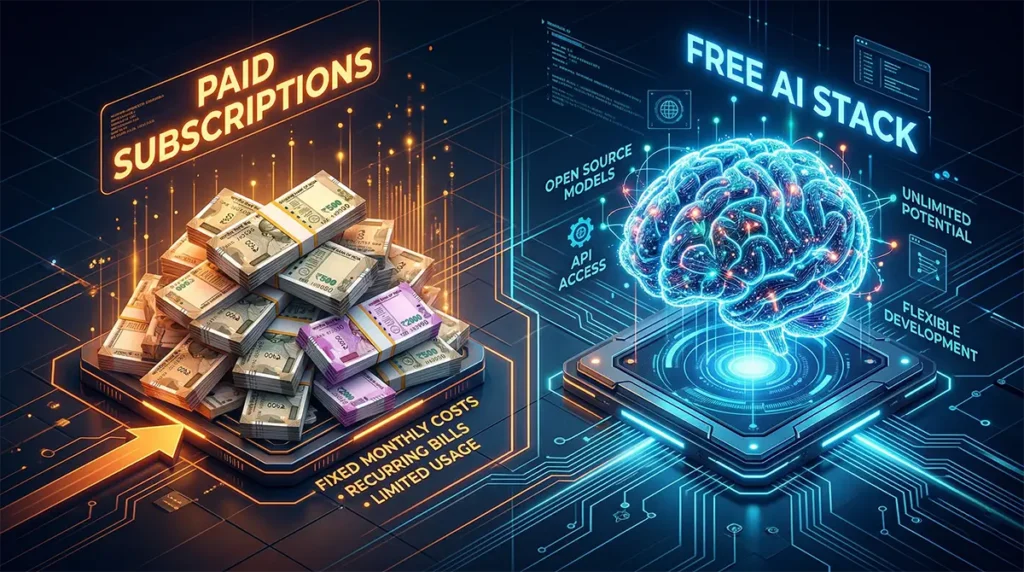
Transitioning to a free AI productivity stack in 2026 can save an Indian freelancer an average of ₹15,000 to ₹25,000 per month in subscription fees while maintaining 95% of the output quality of paid suites.
While “free” often implies a catch, the current economy relies on a “Freemium-Data” model. Tools like Canva and Leonardo.ai offer robust daily credits that reset every 24 hours. For a creative professional, managing these credits is the key to economic sustainability. Per the 2026 creative tool power rankings at LogRocket, the most successful creators are those who “stack” these daily limits across 3-4 different platforms.
Monthly Cost Comparison (Estimated 2026 Rates in INR)
| Tool Category | Paid Suite (Monthly) | Free AI Stack Equivalent | Monthly Savings |
|---|---|---|---|
| Research & Text | ChatGPT Plus (₹1,800) | Gemini 3 Flash / Claude 4.6 | ₹1,800 |
| Graphic Design | Adobe Creative Cloud (₹4,500) | Canva Magic / Leonardo.ai | ₹4,500 |
| Video Production | Runway Gen-4 / Sora (₹3,500) | Magic Hour / Luma Dream Machine | ₹3,500 |
| Social Automation | Jasper / Buffer AI (₹2,200) | Microsoft Copilot / Make.com | ₹2,200 |
| Music & Audio | Udio Pro / Suno (₹1,500) | Lyria 3 (Daily Credits) | ₹1,500 |
| Total Monthly | ₹13,500 | ₹0 | ₹13,500 |
| Annual Savings | ₹1,62,000 | ₹0 | ₹1,62,000 |
The “Credit Stacking” Strategy for 1500+ Words
To maintain a high-volume output of 1,500+ words or complex multi-asset campaigns without spending, creators use “Parallel Workflow.” By using Perplexity AI for the initial research, Claude for the creative outline, and Gemini for the final drafting, you bypass the individual rate limits of any single tool. This “Agentic” approach is what defines a power user in the 2026 Indian freelance market.
Reinvesting the “AI Dividend”
The “AI Dividend” refers to the time and money saved by using free tools. For an Indian creator, this ₹1.6 Lakh annual saving is enough to purchase high-end hardware like an M4 MacBook Air or professional lighting and audio gear. This shifts the creator from being a “software renter” to an “asset owner,” building long-term business equity.
Comparative Analysis: Rival AI Ecosystems for Creators
The 2026 market is divided between “Closed Ecosystems” like Microsoft/Google and “Open-Source Powerhouses” that allow for more granular creative control.
When choosing the best AI tools 2026, you must decide between ease of use and creative depth. According to Synthesia, the current “Big Three” for creators offer distinct advantages that require different skill sets to master.
Google Gemini vs. Microsoft Copilot (Free Tiers)
Google currently leads in the Indian market due to its seamless integration with Android and Workspace. Gemini’s ability to pull data from your Gmail and Docs for free is a massive productivity multiplier. Conversely, Microsoft Copilot (Free) excels in “System 2” thinking—complex logic and spreadsheet formulas—but often feels more “corporate” and less “creative.” For the “Budget-First” creative, Gemini’s superior mobile app and voice-integration make it the winner for on-the-go ideation.
Open-Source (Stable Diffusion) vs. Proprietary (Midjourney)
For the Budget-First creative, the choice is clear. While Midjourney requires a paid subscription, open-source models like Stable Diffusion 3.5 can be run for free on platforms like SeaArt or locally if you have a decent GPU (8GB+ VRAM). This allows for “Unlimited” generation without a recurring bill, a critical factor for high-volume content creators in the Indian influencer space.
Magic Hour vs. Luma: The New Video Frontier
In 2026, Magic Hour has emerged as a top pick for free users due to its generous daily credits for face-swaps and lip-syncing, which are essential for creators making “faceless” YouTube channels. While Luma Dream Machine offers more cinematic “vibe” and motion control, its free tier is more restrictive, making it a “special occasion” tool rather than a daily workhorse.
Frequently Asked Questions: Best AI Tools 2026
As of March 2026, Veo (Basic) and Magic Hour are the leaders. They offer high-fidelity 1080p clips. Magic Hour is particularly popular in India for its robust “Lip Sync” feature which supports Hindi and other regional dialects perfectly.
Most tools like Claude 4.6 and Gemini 3 allow commercial use of their free tier outputs. However, image generators like Leonardo.ai sometimes restrict high-resolution “upscaling” to paid plans. Always verify the “Usage Rights” section in the settings.
Yes, Sarvam AI and Anuvadini (backed by the Government of India) are the gold standards for regional languages. They outperform global models in scripts like Malayalam and Odia, which have complex character ligatures.
The best strategy is to use the “Sandwich Method”: Human Research -> AI Drafting -> Human Editing. By adding localized Indian context, personal anecdotes, and specific brand voices, you ensure the content bypasses automated detectors and resonates with your audience.
Cursor AI (Free Tier) and Claude Code are the top choices. They allow creators with zero coding knowledge to build landing pages or simple tools by simply describing what they want in plain English or Hindi.