

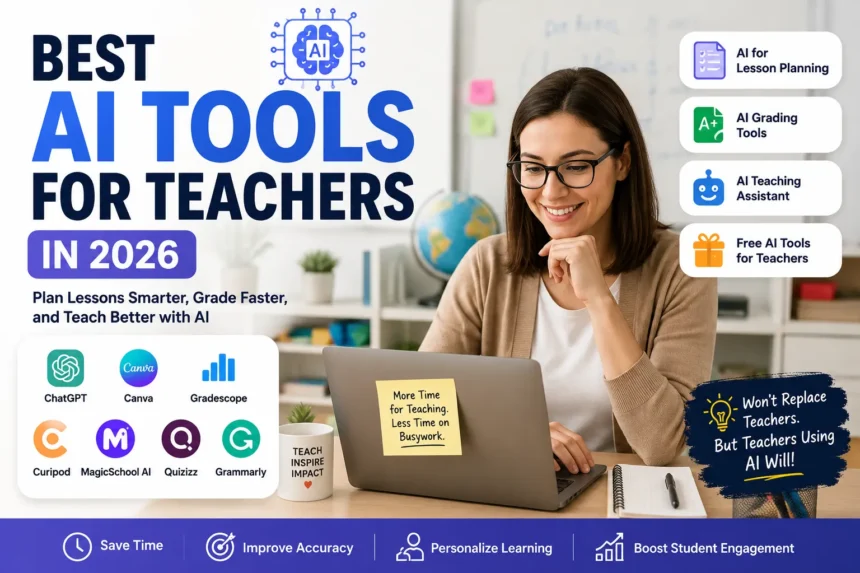
Technology is changing classrooms faster than ever, and in 2026, teachers are using AI not just to save time but also to create smarter, more engaging learning experiences. From lesson planning to grading assignments, AI tools are helping educators manage their workload while improving student learning.
The rise of AI tools for teachers has made teaching more efficient, creative, and personalized. Whether you teach in a school, college, coaching center, or online classroom, AI can help simplify daily tasks and reduce burnout.
In this guide, we’ll explore the best AI tools teachers can use in 2026 and how they can improve teaching, lesson planning, grading, and classroom management.
Why Teachers Are Using AI in 2026
Teachers today handle much more than classroom teaching. They prepare lesson plans, grade assignments, create presentations, answer student questions, and manage administrative work.
This is where AI becomes useful.
Modern AI tools can:
- Generate lesson plans in minutes
- Create quizzes and worksheets
- Provide instant grading support
- Personalize learning material
- Act as a virtual teaching assistant
- Save hours of repetitive work
The biggest advantage is that teachers have more time to focus on students rather than on paperwork.
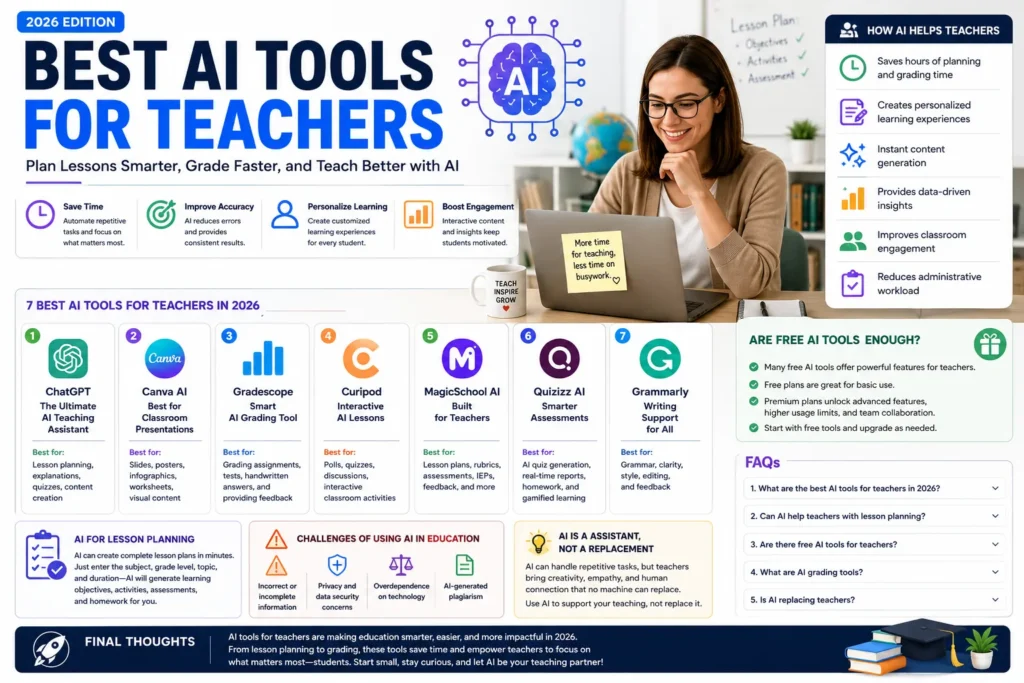
1. ChatGPT – The Ultimate AI Teaching Assistant
One of the most popular AI tools for teachers in 2026 is OpenAI’s ChatGPT.
Teachers use ChatGPT for:
- Creating lesson plans
- Writing quizzes
- Explaining complex topics simply
- Generating classroom activities
- Drafting emails to parents
- Creating homework assignments
It works like a smart AI teaching assistant, available 24/7.
For example, a history teacher can ask ChatGPT to create a 40-minute lesson on World War II for grade 8 students with activities and quiz questions.
Teachers also use it for multilingual support and simplified explanations for slow learners.
2. Canva AI – Best for Classroom Presentations
Canva has become a favorite platform among educators. Its AI-powered tools help teachers design:
- Presentation slides
- Infographics
- Classroom posters
- Worksheets
- Certificates
The Magic Design feature can instantly create presentation layouts from simple prompts.
Teachers no longer need graphic design skills to create professional classroom material.
This tool is especially useful for visual learning and student engagement.
3. Gradescope – Smart AI Grading Tool
Grading is one of the most time-consuming tasks for teachers. That’s why many educators now rely on AI grading tools like Gradescope.
Gradescope helps teachers:
- Grade assignments faster
- Automate repetitive scoring
- Evaluate handwritten answers
- Provide consistent feedback
It is widely used in colleges and universities, especially for mathematics, coding, and science subjects.
Instead of manually checking every paper, teachers can create grading patterns that AI follows automatically.
This reduces workload while improving grading accuracy.
4. Curipod – Interactive AI Lessons
Curipod is gaining popularity in modern classrooms because it creates interactive learning experiences.
Teachers can generate:
- Polls
- Quizzes
- Icebreaker activities
- Student discussions
- AI-generated presentations
The platform makes lessons more engaging and student-friendly.
If you are looking for AI to help with lesson planning, Curipod can create entire lesson structures in just a few minutes.
It works particularly well for middle school and high school classrooms.
5. MagicSchool AI – Built Specifically for Teachers
MagicSchool AI is one of the fastest-growing free AI tools for teachers in 2026.
Unlike general AI chatbots, this platform is designed specifically for education.
Teachers can use it to:
- Create rubrics
- Build lesson plans
- Generate assessments
- Write IEPs
- Create student feedback
The platform focuses on saving teacher time while maintaining educational quality.
Many schools are adopting MagicSchool AI because it is easy to use even for beginners.
6. Quizizz AI – Smarter Assessments
Quizizz has evolved into a powerful AI classroom tool.
Teachers can now generate quizzes instantly using AI prompts. The platform also analyzes student performance and identifies weak areas.
Features include:
- AI quiz generation
- Real-time classroom participation
- Homework assignments
- Gamified learning
Students enjoy the interactive experience, while teachers get detailed analytics.
This tool makes assessments more fun and effective.
7. Grammarly – Writing Support for Teachers and Students
Grammarly is no longer just a grammar checker. In 2026, it became a powerful AI writing assistant.
Teachers use it for:
- Correcting grammar
- Improving writing clarity
- Drafting academic content
- Reviewing student essays
Students also benefit by improving their writing skills independently.
For language teachers, Grammarly can save significant editing time.
How AI Is Changing Lesson Planning
One of the biggest uses of AI in education is AI for lesson planning.
Earlier, teachers spent hours preparing:
- Learning objectives
- Activities
- Assessments
- Homework
- Presentation content
Now, AI can generate customized lesson plans within minutes.
Teachers simply enter:
- Subject
- Grade level
- Topic
- Duration
The AI then creates structured lessons with activities and learning goals.
This allows educators to spend more time teaching and less time planning.
Are Free AI Tools Enough for Teachers?
Many educators wonder if paid tools are necessary.
The good news is that several free AI tools for teachers already provide excellent features.
Free versions often include:
- Basic lesson generation
- Quiz creation
- Writing assistance
- Classroom templates
However, premium plans usually offer:
- Advanced analytics
- Team collaboration
- More AI credits
- Enhanced customization
For individual teachers, free tools are often enough to get started.
Challenges of Using AI in Education
Although AI offers many benefits, teachers should use it carefully.
Some common concerns include:
- Incorrect information from AI
- Overdependence on technology
- Reduced human interaction
- Privacy concerns
- AI-generated plagiarism
Teachers should always review AI-generated content before using it in classrooms.
AI should support teachers, not replace them.
Final Thoughts
The future of education is increasingly technology-driven, and AI tools for teachers are now essential in modern classrooms.
From AI grading tools to smart lesson planners and virtual assistants, AI is helping teachers save time, improve productivity, and create engaging learning experiences.
Tools like ChatGPT, Canva, Gradescope, and MagicSchool AI are transforming how teachers teach in 2026.
The best approach is to start small. Explore one or two AI tools, test them in your classroom, and gradually build your workflow around them.
When used wisely, AI can become one of the most valuable teaching companions for educators worldwide.
FAQs
1. What are the best AI tools for teachers in 2026?
Some of the best AI tools include ChatGPT, Canva AI, Gradescope, Curipod, MagicSchool AI, Quizizz, and Grammarly.
2. Can AI help teachers with lesson planning?
Yes, AI can create structured lesson plans, classroom activities, quizzes, and homework in just a few minutes.
3. Are there free AI tools for teachers?
Yes, many platforms, such as MagicSchool AI, Canva, ChatGPT, and Quizizz, offer free plans for teachers.