

Have you ever spent hours studying only to forget most of it a few days later? If your answer is yes, you’re definitely not alone. Many students believe that studying longer automatically leads to better results. In reality, the way you study often matters much more than the number of hours you spend with your books open.
Over the years, researchers have studied how the brain learns and remembers information. The findings are surprisingly clear: some study techniques work extremely well, while others only create the illusion of learning. For example, reading the same chapter five times might make you feel productive, but it often isn’t the most effective way to remember information long-term.
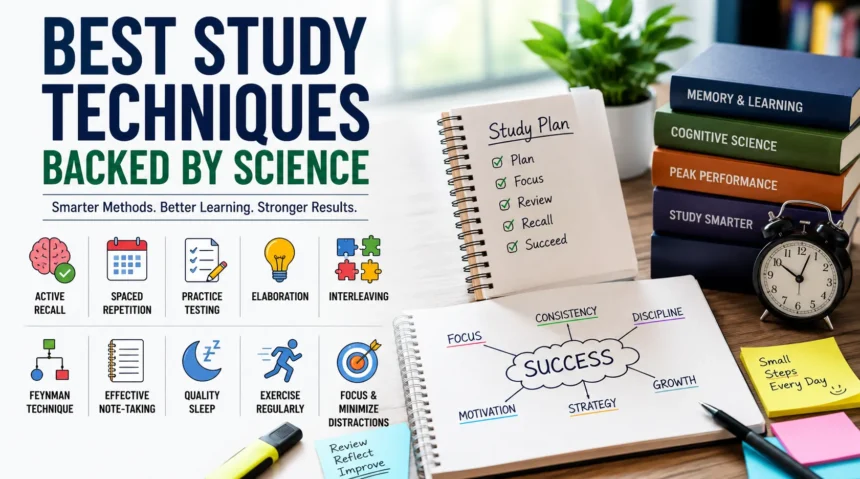
Best Study Techniques Backed by Science
The good news is that science has identified several study methods that genuinely improve learning, memory, and exam performance. In this guide, we’ll look at the best study techniques backed by research and explain how you can use them in your daily routine.
1. Active Recall: The Most Powerful Study Technique
If there’s one study method that consistently appears at the top of research findings, it’s active recall. Active recall simply means forcing your brain to retrieve information from memory instead of repeatedly reading it. Every time you actively remember something, you strengthen the neural connections associated with that information.
For example, instead of rereading your history notes, close the notebook and try to write down everything you remember about a particular topic. Then compare your answers with the original material and identify any gaps. Flashcards are another excellent form of active recall. You look at a question, attempt to answer it from memory, and then check whether you’re correct. Although active recall feels harder than rereading notes, that’s exactly why it works so well. The mental effort involved helps information stay in your memory for much longer.
2. Spaced Repetition
Many students rely on cramming the night before an exam. While this might help with short-term memory, most of the information quickly disappears afterward. Spaced repetition takes the opposite approach. Instead of reviewing material once, you revisit it at increasing intervals over time. For example, you might study a topic today, review it again tomorrow, then three days later, then a week later, and so on.
This technique works because your brain strengthens memories each time you’re about to forget them. The repeated exposure helps move information from short-term memory into long-term memory. Many modern study apps use spaced repetition automatically, but you can also create a simple review schedule on your own. Students who use spaced repetition often remember information for months or even years instead of just a few days.
3. Practice Testing
One of the most effective ways to prepare for a test is by taking practice tests. Research shows that testing yourself is not only a way to measure learning but also a powerful learning method itself. Every time you answer questions, solve problems, or complete quizzes, your brain becomes better at retrieving information under pressure. Practice tests also help you identify weak areas before the actual exam.
Instead of discovering gaps in your knowledge during the test, you find them early enough to fix them. The closer your practice sessions resemble the real exam, the better prepared you’ll be.Even if your teacher doesn’t provide practice papers, creating your own questions can be extremely beneficial.
4. The Feynman Technique: Teach to Learn
One of the simplest and most effective study methods comes from physicist Richard Feynman. The idea is straightforward: if you can explain something clearly to another person, you truly understand it. Choose a topic you’ve been studying and try explaining it using simple language, as if you’re teaching a younger student. Avoid technical terms whenever possible.
As you explain, you’ll quickly notice any areas where your understanding is incomplete. These weak spots become obvious because they’re difficult to explain clearly. Once you’ve identified those gaps, return to your study material, review the topic, and try explaining it again. Many students are surprised by how much this technique improves comprehension.
5. Interleaving: Mix Different Subjects Together
Most people study one topic at a time for several hours. While this feels organized, research suggests that mixing different topics can often improve learning. This approach is known as interleaving. For example, instead of spending three straight hours on mathematics, you might study math for an hour, switch to science for an hour, and then review history afterward.
The constant switching forces your brain to adapt and distinguish between different concepts. This process improves problem-solving skills and long-term retention. Interleaving may feel more difficult because your brain has to work harder. However, that extra effort often leads to stronger learning outcomes.
6. Note-Taking the Smart Way
Taking notes remains an important part of studying, but not all note-taking methods are equally effective. Many students simply copy information word for word. While this creates neat notes, it doesn’t always encourage understanding. A better approach is to summarize information using your own words. This forces you to process the material rather than simply recording it. The Cornell Note-Taking System is particularly useful. It divides your page into sections for notes, key questions, and summaries. This structure makes reviewing much easier later on. Good notes should help you think about information, not just store it.
7. Sleep Quality
Many students sacrifice sleep in order to study more. Ironically, this often makes learning less effective. Sleep plays a crucial role in memory consolidation. During sleep, the brain processes and organizes information learned throughout the day. Research consistently shows that students who get adequate sleep perform better on exams than those who stay awake late studying. Instead of pulling all-nighters, try reviewing material earlier and prioritizing a full night’s rest. Think of sleep as part of your study plan rather than something that gets in the way of studying.
8. Exercise and Learning
Physical activity doesn’t just improve physical health. It also benefits brain function. Exercise increases blood flow to the brain and supports the growth of new neural connections. Studies have linked regular physical activity to improved concentration, memory, and cognitive performance. You don’t need intense workouts to experience these benefits. Even a short walk, light jog, or cycling session can help clear your mind and improve focus. Many students find that studying becomes easier after some form of physical activity.
9. Eliminate Multitasking
Modern technology makes distractions almost impossible to avoid. Social media notifications, text messages, and endless internet browsing constantly compete for attention. However, research shows that multitasking reduces learning efficiency. Every time you switch between studying and checking your phone, your brain needs time to refocus. These interruptions add up quickly and significantly reduce productivity. Creating distraction-free study sessions can dramatically improve learning quality. Even studying for one focused hour is often more effective than spending three distracted hours at your desk.
10. Build a Consistent Study Routine
One of the biggest differences between successful students and struggling students isn’t intelligence. It’s consistency. Studying a little every day is usually more effective than trying to learn everything at the last minute. A regular study routine trains your brain to focus during specific times of the day. Over time, studying becomes a habit rather than a constant battle against procrastination. Even short daily study sessions can produce remarkable results when maintained consistently.
Final Thoughts
The best study techniques aren’t necessarily the most popular ones. Science shows that methods like active recall, spaced repetition, practice testing, and teaching others are far more effective than simply rereading notes or highlighting textbooks. Learning isn’t about spending the most time studying. It’s about using your time wisely. By combining these research-backed techniques with good sleep, regular exercise, and consistent habits, you’ll not only improve your grades but also remember information for much longer. In 2026, studying smarter, not harder, remains the most effective path to academic success.
For more educational information, make sure to check out this website.
FAQ
Q. What is the most effective study technique according to science?
A. Active recall is widely considered the most effective study technique. Instead of simply rereading notes, it requires you to retrieve information from memory through self-testing, flashcards, or practice questions. Research shows that actively recalling information helps strengthen memory and improves long-term retention.
Q. How many hours should I study each day?
A. There is no perfect number that works for everyone, but consistency matters more than long study sessions. Most students benefit from studying for 1–3 focused hours per day rather than cramming for several hours before exams. Short, distraction-free sessions combined with regular review tend to produce the best results.
Q. Is highlighting textbooks a good study method?
A. Highlighting can be useful for marking important information, but it should not be your primary study method. On its own, highlighting is considered a passive learning technique and often leads to lower retention. It works best when combined with active recall, practice testing, and spaced repetition.