

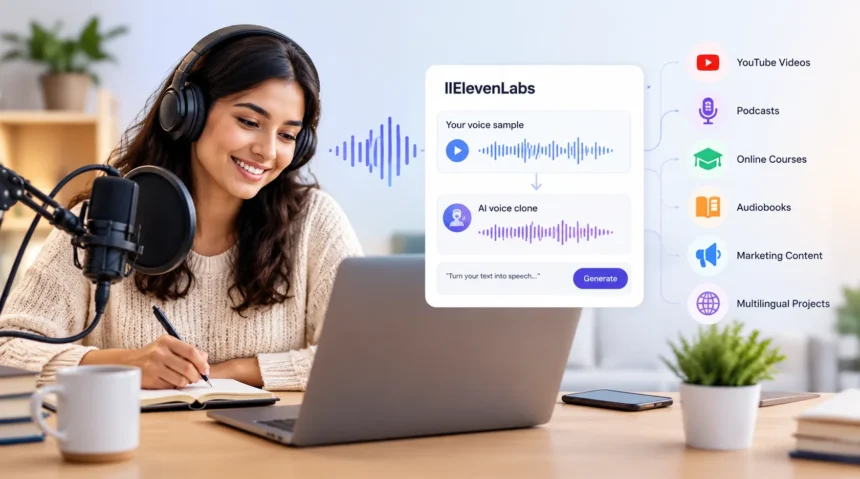
What if you could create a voiceover for your next video without booking a recording studio, or finding a voice actor? That is where AI voice technology is changing the content creation process.
For creators, marketers, YouTubers, podcasters, and businesses, producing content is not always the hard part. The time-consuming bit often comes afterward: recording voiceovers, fixing mistakes, matching the right tone, creating different versions, and sometimes recording the same content in multiple languages.
ElevenLabs voice cloning offers a simpler way to handle much of this work. Instead of recording every piece of content from scratch, creators can use a cloned version of a voice to generate speech from written text. When used responsibly and with the proper permission, this can make voice-based content much faster and easier to produce.
What Is ElevenLabs Voice Cloning?
ElevenLabs is an AI audio platform that offers tools for generating and working with synthetic voices. Its voice cloning technology can create an AI version of a person’s voice from voice recordings, which can then be used to turn written scripts into spoken audio. The idea is fairly simple. You provide a voice sample, and the system analyzes characteristics such as pronunciation, tone, rhythm, and vocal qualities. Once a suitable voice model is created, text can be converted into speech using that voice.
This can be particularly useful when the same person needs to provide voiceovers regularly. Imagine a YouTube creator who publishes three videos every week. Instead of recording every script manually, they could prepare the scripts and generate voiceovers using their approved AI voice. The creator can then spend more time on the actual video, storytelling, editing, and ideas. That is where the real convenience comes in.
Why And How ElevenLabs Voice Cloning Can Simplify Content Creation?
Creating content at scale sounds exciting until you actually have to do it. More videos mean more scripts, more recordings, more edits, and more opportunities for small mistakes. Voice cloning can remove some of that repetitive work.
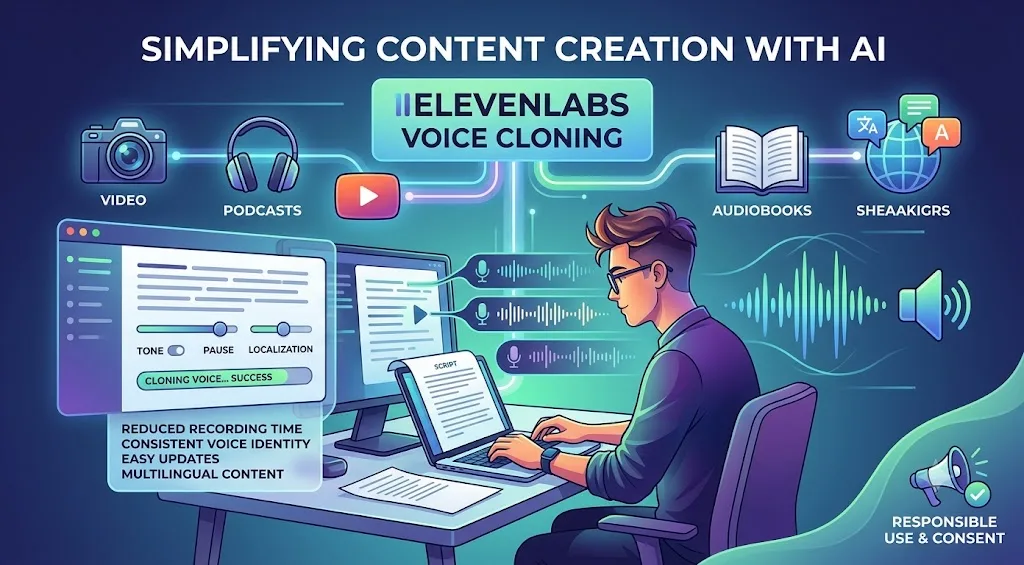
1. It Reduces Repeated Recording
Recording a voiceover can take much longer than simply reading a script once. A 10-minute video may require several takes because of pronunciation mistakes, background noise, forgotten lines, awkward pauses, or changes that need to be made later. And sometimes, one tiny script change means recording an entire section again.
With voice cloning, the creator can make the change in the script and generate a new version instead of setting up a microphone and recording the section again. This is especially useful for creators who publish frequently.
2. It Helps Maintain a Consistent Voice
Consistency matters when you’re building a recognizable content brand. A YouTube channel, podcast, online course, or business may want every piece of content to have a similar vocal identity. But human recordings naturally vary. Your energy might be higher on Monday and lower on Friday. You may sound slightly different after a long day of recording.
An approved AI voice can provide a more consistent delivery across different pieces of content. This doesn’t mean every line will automatically sound perfect. Good scripts, suitable pacing, and thoughtful editing still matter. But the technology can make maintaining a consistent voice easier.
3. It Makes Content Updates Much Simpler
This is one of the less obvious benefits of voice cloning. Suppose a company creates an explainer video about its software. Six months later, one feature has changed. The video still works, but one section contains outdated information.
With a traditional voiceover, fixing that section may mean contacting the voice actor or recording it again. With a properly authorized cloned voice, the updated script can be turned into a new voiceover without recreating the entire recording session. For tutorials, product videos, online courses, and other information-heavy content, that can save considerable time.
4. It Can Help With Multilingual Content
Creating content for an international audience usually means more than translating the words. The content also needs a suitable voiceover for each language. AI voice technology can make this process easier by allowing creators to produce localized audio versions of existing content. This can be useful for businesses that want to adapt videos, educational material, marketing content, or other media for audiences in different markets.
ElevenLabs also offers dubbing tools designed for multilingual content, making AI audio particularly relevant for creators trying to reach audiences beyond their native language. Of course, localization still needs human attention. A direct translation may not always capture local expressions, cultural references, or the way people naturally speak. AI can speed up the production process, but human review remains valuable.
Voice Cloning Is Useful Beyond YouTube
It is easy to associate AI voice cloning with YouTube, but there are plenty of other applications.
Podcasts
Podcasters can use voice generation to create certain types of audio content, make corrections, or produce additional versions of existing material. For a podcast that publishes frequently, reducing the amount of repeated recording can be a major advantage.
Audiobooks
Audiobooks require a huge amount of narration. For certain projects, AI-generated narration can help creators produce audio versions of written content more efficiently. The final result still needs to sound natural and fit the type of book being produced, but AI can reduce the amount of manual recording involved.
Online Courses
Course creators often have to record hours of lessons. If a mistake is discovered after publishing, correcting a single sentence can be frustrating. Voice cloning can make these small updates easier, particularly when maintaining the same voice throughout a large library of lessons.
Marketing Content
Brands create a surprising amount of short-form content: advertisements, product explainers, social media videos, tutorials, and promotional clips. Instead of organizing a new recording session for every variation, teams can use an approved AI voice to generate different scripts and versions. That can make content production more flexible.
Does Voice Cloning Replace Human Voice Actors?
Not necessarily. This is where the conversation around AI voices can become a little too black and white. Voice cloning is a tool. It can make certain types of production faster, but it does not automatically make human narration unnecessary. A professional voice actor brings interpretation, emotion, timing, personality, and creative judgment to a performance.
Those qualities can be particularly important for commercials, dramatic storytelling, character work, and emotionally sensitive content. AI voice generation is more useful when the priority is speed, consistency, scalability, or making frequent changes. For many creators, the better approach may not be choosing between humans and AI. It may be deciding where each one makes the most sense.
What Makes a Voice Clone Sound Good?
Having access to voice cloning does not automatically mean the final audio will sound professional. The quality of the source recording matters. Clear audio gives the system better material to work with. The script matters too. A badly written sentence can sound awkward regardless of how good the voice is.
Punctuation also plays a role because it can influence pauses and delivery. Creators should also think about how the voice fits the content. A serious business presentation may require a different delivery style from a funny social media video. In other words, voice cloning can simplify production, but it does not remove the need for good content decisions.
The Importance of Consent and Responsible Use
Voice cloning also comes with an important responsibility: only clone and use voices with the necessary permission. A person’s voice is closely connected to their identity. Using someone’s voice without authorization can create serious ethical and legal concerns, especially if the generated audio makes them appear to say something they never actually said.
For creators and businesses, the safest approach is to use their own voice or a voice for which they have clear authorization and to follow the platform’s current rules around voice cloning and synthetic media. Transparency can also matter. Depending on how and where AI-generated audio is used, audiences may benefit from knowing that the voice is synthetic. The technology becomes much more useful when it is treated as a creative and production tool rather than a way to imitate people without permission.
How Creators Can Get More From ElevenLabs Voice Cloning?
The biggest benefit comes from using voice cloning as part of a wider content workflow. Start with a strong script. Decide where the audio will be used. Break longer content into manageable sections. Review pronunciation and pacing before publishing. And keep a human editor involved, especially for important business or public-facing content. It is also worth creating different versions of content instead of simply producing more of the same thing.
For example, one long-form article could become a video script, podcast episode, short social video, and audio clip. An AI voice can then help produce the spoken versions without requiring a completely new recording session every time. That is where the technology becomes genuinely useful: not just generating a voice, but helping creators get more value from the content they already have.
Final Thoughts
ElevenLabs voice cloning can make content creation faster by reducing the need for repeated voice recordings. It can help creators produce voiceovers for YouTube videos, podcasts, online courses, audiobooks, marketing campaigns, and multilingual content with greater flexibility. However, AI works best as a support tool rather than a replacement for good content. A strong script, natural delivery, careful editing, and responsible voice use still matter. For creators who regularly produce voice-based content, voice cloning can simplify updates, reduce recording time, and make the entire voiceover process more efficient, consistent, and adaptable.
For more Technological And Software related details, make sure to check out this website.
FAQs
1. Is ElevenLabs voice cloning useful for YouTube creators?
A. Yes. YouTube creators can use an authorized AI voice to generate voiceovers for videos, make script changes without rerecording everything, and create more content without spending as much time behind a microphone.
2. Can ElevenLabs voice cloning create different versions of the same content?
A. Yes. Creators can generate voiceovers from different scripts and adapt existing content for different videos, platforms, or audiences. This can be particularly helpful when creating multiple versions of similar content.
3. Is it legal to clone someone’s voice with AI?
A. Voice cloning should only be used when you have the appropriate permission or rights to use the voice. Cloning someone else’s voice without authorization can raise ethical, privacy, personality-rights, or other legal concerns depending on the situation and jurisdiction.