


Ever opened your wallet and thought, “Wait, where did all my money go?” You’re not alone. Pocket money, a birthday gift, your first paycheck. It all vanishes fast, and you’re left with a half-eaten snack and a few regrets.
Learning how to budget isn’t hard. It isn’t boring either, and it isn’t only for adults with fancy jobs. This guide walks you through budgeting for beginners using one of the simplest methods out there: the 50/30/20 rule. By the end, you’ll know how to build a simple budget plan and run your monthly budget like a pro.
What Is a Budget, Really?
A budget is just a plan for your money. Think of it like a game plan before a cricket match. You don’t walk onto the field without knowing who bats first or who bowls, right? In the same way, a budget tells your money where to go before you spend it.
A budget is not a punishment, and it doesn’t mean you can never have fun. It simply helps you:
- Know exactly how much money you have
- Spend on the things that matter most
- Stop running out of money before the month ends
- Save up for things you really want
Why Should You Start Budgeting Early?
You might think, “I’m just a student, why do I need a budget?” Here’s the secret: the habits you build now will stay with you for life. If you learn to manage ₹500 well, managing ₹50,000 later will feel much easier.
Starting early also gives you a head start. Imagine saving a little every month for years. Small amounts add up faster than you’d think.
Meet the 50/30/20 Rule
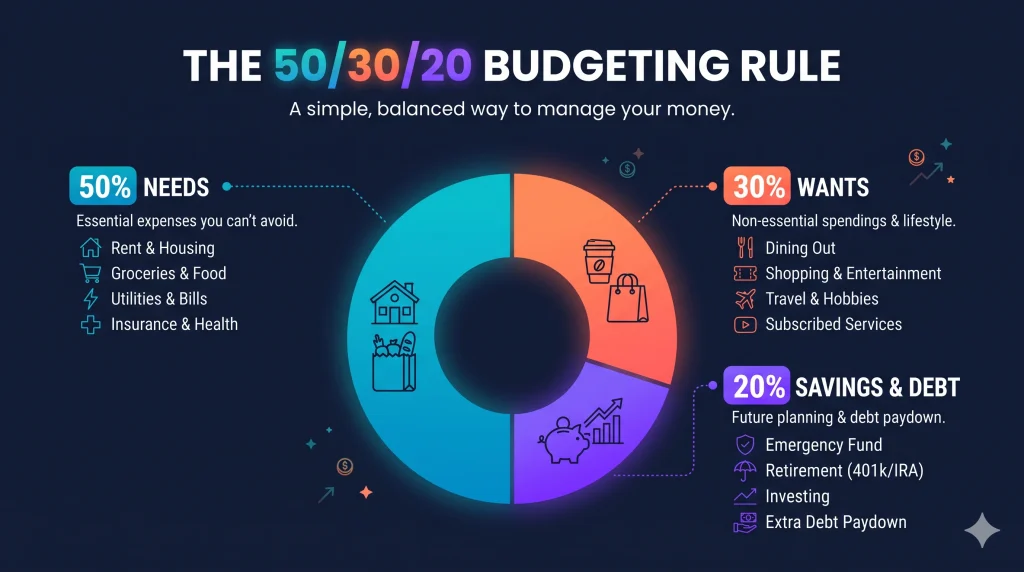
The 50/30/20 rule is one of the simplest ways to split your money. Instead of tracking every single rupee, you divide your income into just three buckets:
| Share | Bucket | What It Means |
| 50% | Needs | Things you must have |
| 30% | Wants | Things you’d like to have |
| 20% | Savings | Money for your future |
50% for Needs
Needs are the things you can’t live without. If you skip them, life gets difficult. For a student or beginner, needs might include:
- Food and basic groceries
- School or college fees
- Transport to school or work
- Phone recharge (if you genuinely need it)
- Rent and electricity bills (for adults)
Half of your money goes here. If your needs take up more than half, don’t panic. It just means you may need to adjust the other buckets a little.
30% for Wants
Now for the fun part. Wants are things that make life enjoyable but aren’t essential. Examples include:
- Movies and outings with friends
- Video games and in-app purchases
- Snacks, ice cream, and eating out
- New clothes, shoes, or gadgets
- Hobbies and subscriptions
Here’s a tip: not every want is bad. The 50/30/20 rule actually gives you permission to enjoy your money. You just have a limit, so you don’t overspend.
20% for Savings
This bucket is for your future self. It’s the money you set aside and don’t touch for everyday spending. You can use it for:
- An emergency fund, which is a small cushion for surprises like a broken phone
- Big goals, like a new bicycle, a laptop, or a trip
- Long-term dreams, like higher studies or starting a business
Even if 20% feels like a lot, start with whatever you can manage. Saving 5% is far better than saving nothing.
A Simple Example
Let’s make this real. Say you get ₹2,000 a month as pocket money or from a part-time task. Here’s how the 50/30/20 rule splits it:
| Bucket | Percentage | Amount |
| Needs | 50% | ₹1,000 |
| Wants | 30% | ₹600 |
| Savings | 20% | ₹400 |
So you’d keep ₹1,000 for essentials, enjoy ₹600 guilt-free, and tuck away ₹400 for later. If you do this for a year, you’ll have saved ₹4,800 without even feeling it!
How to Make Your Own Monthly Budget in 5 Steps
Ready to try it yourself? Follow these easy steps:
- Find your income. Add up all the money you receive in a month, such as pocket money, gifts, or earnings.
- Do the math. Multiply your income by 0.50, 0.30, and 0.20 to get your three amounts.
- Sort your spending. Write down what you usually spend money on and place each item in Needs or Wants.
- Move savings first. As soon as you get your money, set aside the 20%. Saving first, spending later is a powerful trick.
- Track and adjust. At the end of the month, check how you did. A notebook, a phone note, or a simple app works perfectly.
Common Mistakes Beginners Make
Everyone slips up at the start, so don’t feel bad. Here are a few things to watch out for:
- Mixing up needs and wants. A phone is a need, but the newest, most expensive model is a want.
- Forgetting small expenses. Little snacks and online purchases add up quickly.
- Skipping savings. Don’t wait to see what’s “left over.” There’s usually nothing left.
- Giving up too soon. Your first budget won’t be perfect, and that’s okay. Keep tweaking it.
What If the Numbers Don’t Fit?
The 50/30/20 rule is a guide, not a strict law. If your needs take up 60% of your money, you could try 60/20/20 instead. If you’re serious about learning “how to budget”- you might go 50/20/30 with more toward savings. The best budget is the one that works for your life.
Final Thoughts
Learning how to budget doesn’t need to be scary or complicated. With the 50/30/20 rule, you only need to remember three numbers: 50 for needs, 30 for wants, and 20 for savings. Start small, stay consistent, and be kind to yourself when you make mistakes.
The best time to build a good money habit is right now. Grab a notebook, write down your income, and make your very first budget plan today. Your future self will thank you!
FAQs
What is the 70-10-10-10 rule for money?
70-10-10-10 rule: Split your income into 70% for living expenses, 10% for savings, 10% for investing, and 10% for donating or giving back.
What is the 3 6 9 rule in finance?
3-6-9 rule: Keep an emergency fund that covers 3 months of expenses if your income is stable, 6 months if it’s less stable, and 9 months if it’s very uncertain (like freelancers or business owners).
What is the 7 7 7 rule for money?
7-7-7 rule: Save or invest ₹7,000 (or any fixed amount) every month for 7 years at a 7% return to see how your money grows steadily over time. Note that this rule has no single official meaning, so different sources define it differently.