

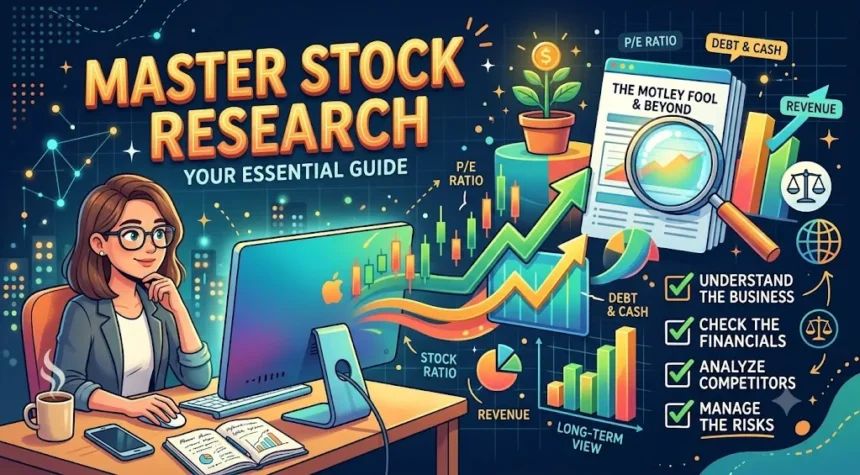
What if you could research a stock without spending hours trying to understand complicated financial terms? That is where The Motley Fool can be useful.
The platform offers stock analysis, investing news, financial guides, market commentary, and educational content that can help investors understand companies before putting their money into them. But there is one important thing to remember.
Reading an article about a stock does not automatically mean you should buy it. Good investing research means understanding the business, checking its financial health, looking at its competitors, considering the risks, and deciding whether the investment makes sense for you.
Why Use The Motley Fool To Research Stocks Before Investing?
The Motley Fool can be a useful starting point for investors because it brings different parts of stock research together in one place. Instead of only looking at a stock’s current price, you can find information about the company’s business, growth opportunities, financial results, industry, competitors, and long-term prospects.
Its investment philosophy generally focuses on finding quality businesses and holding investments for the long term. That makes the platform particularly useful for people who want to understand the bigger picture instead of making decisions based only on daily price movements. The key is to use the information as a starting point for your own research rather than treating any individual article as a final investment decision.
Start With the Company, Not the Stock Price
It is easy to see a stock that has fallen 20% or 30% and assume it is now a bargain. But a falling stock price does not automatically mean a company is cheap. When researching a company on The Motley Fool, start with basic questions:
- What does the company actually do?
- How does it make money?
- Is its business growing?
- Who are its main competitors?
- Does it have something that makes it different?
- What could hurt its business in the future?
These questions help you understand the company before you start worrying about whether its share price will rise tomorrow.
Read Multiple Articles About the Same Stock
Once you find a company you are interested in, search for several articles about it rather than relying on just one. One article might discuss its latest earnings report, while another could look at its future growth opportunities or valuation. You may also find articles discussing risks or comparing the company with a competitor.
Reading different perspectives helps you avoid forming an opinion too quickly. If five articles are overwhelmingly positive, for example, look specifically for information about the company’s risks. Similarly, if the market is suddenly negative about a company, try to understand whether the problem is temporary or something that could affect the business for years.
Look at the Company’s Financial Numbers

You do not need to be a financial expert to understand some of the basic numbers that matter. Start by looking at revenue and earnings. Revenue tells you how much money the company brings in, while earnings show how much it keeps after expenses. Then look at cash flow and debt. A company may report strong earnings but still have financial problems if it struggles to generate cash or carries too much debt.
Check the P/E Ratio
The price-to-earnings, or P/E, ratio is one of the most commonly discussed valuation measures. It compares a company’s share price with its earnings per share. A lower P/E can sometimes suggest that a stock is cheaper relative to its earnings, while a higher P/E can indicate that investors expect stronger growth. However, do not use P/E by itself. Comparing companies in the same industry usually gives the number more context.
Look at Debt
Debt is another important factor. A company with significant debt may have less financial flexibility, especially when interest rates are high or business conditions become difficult. The goal is not necessarily to find a company with zero debt. Instead, consider whether the company generates enough cash to manage its debt comfortably.
Look for a Competitive Advantage
A company can have good financial numbers today and still struggle in the future if competitors can easily copy its business. This is why it is useful to look for a competitive advantage, sometimes called an economic moat. A strong brand, proprietary technology, a large customer base, low-cost production, or a powerful distribution network can make it difficult for competitors to take away market share. When reading The Motley Fool’s analysis, pay attention to these details. They can tell you why a company might continue performing well several years from now.
Research the Management Team
The people running a company matter just as much as its products. Look at the company’s CEO and senior management. Consider their experience and the decisions they have made over the years. You can also look at how management uses company cash. Is it investing in growth? Paying down debt? Buying back shares? Acquiring other businesses? Insider ownership can also provide useful information, although it should never be treated as proof that a company is automatically a good investment.
Understand the Industry
Do not look at a company in isolation. The industry it operates in can have a major impact on its future. A company may be performing well today, but changes in technology, customer habits, regulations, or competition could affect it later.
For example, when researching a technology company, you may want to understand broader trends in artificial intelligence, cloud computing, cybersecurity, or digital services. The Motley Fool’s industry-focused articles can help you understand these larger trends and how individual businesses could benefit from or be hurt by them.
Compare the Company With Its Competitors
Comparing companies can make stock research much easier. Suppose you are interested in two companies that sell similar products. Look at their revenue growth, profitability, debt, valuation, market share, and competitive advantages.
You may discover that one company is growing faster but is also much more expensive. Another might be cheaper but have slower growth. There is no single number that tells you which stock is better. Looking at several factors together gives you a more complete picture.
Use Free Content Before Paying for More Research
You do not necessarily need a paid subscription to start using The Motley Fool. The website offers a large amount of free investing content, including stock articles, educational guides, podcasts, and market-related information.
Its premium services offer additional research, recommendations, rankings, and investing tools. However, beginners can start with the free material and decide later whether they need additional resources. The important thing is to understand what you are paying for and whether it actually adds value to your own research process.
Create Your Own Stock Research Checklist
After reading The Motley Fool’s articles, create a simple checklist before making an investment decision. Ask yourself:
- Do I understand the business?
If you cannot explain how the company makes money, spend more time researching it. - Is the company growing?
Look at revenue, earnings, customers, and future opportunities. - Is the balance sheet healthy?
Check debt, cash, and cash flow. - Does the company have an advantage?
Think about its brand, technology, customers, or other strengths. - Is the stock reasonably valued?
A great company can still be a poor investment if you pay an unreasonable price. - What are the biggest risks?
Think about what could make your investment thesis wrong.
This checklist can stop you from making an investment simply because an article made a stock sound exciting.
Do Not Ignore the Risks
Every investment comes with risk. A company could lose customers, face stronger competition, miss its earnings expectations, take on too much debt, or operate in an industry that changes quickly. This is why it is important to actively look for information that challenges your original opinion.
If you only read articles that support your decision, you may end up seeing exactly what you want to see. Good research should include both the reasons a company could succeed and the reasons it could struggle.
Think Long Term
One of the biggest mistakes new investors make is focusing too heavily on daily stock movements. A stock can rise 5% one day and fall 7% the next without any major change in the underlying business.
The Motley Fool’s investing philosophy emphasizes long-term investing and holding quality stocks through market volatility. That does not mean every stock should be held forever. If the company’s fundamentals change or your original investment reason no longer makes sense, it may be time to reassess. The important thing is to base your decision on the business rather than short-term market noise.
Final Thoughts
The Motley Fool can be a helpful resource when you want to research stocks in a simple and accessible way. Its articles can help you understand a company’s business model, financial performance, competitive position, industry, management, valuation, and potential risks. However, no website can guarantee that a stock will make money. Use The Motley Fool as one part of your research process rather than treating every recommendation as a reason to invest. Take the time to check the company’s financial information, compare competitors, understand the risks, and think about whether the stock fits your own financial goals. A little extra research can help you make a much more informed decision.
For more Financial details, make sure to check out this website.
Frequently Asked Questions
Q. Is The Motley Fool good for beginner investors?
A. Yes. The Motley Fool offers a wide range of educational articles and investing resources written for individual investors. Beginners can use its free content to learn basic concepts and understand how to research individual companies.
Q. Can I use The Motley Fool to find stocks to invest in?
A. Yes, The Motley Fool publishes stock analysis and investment ideas. However, these should be treated as research starting points rather than guaranteed recommendations. Investors should do their own research before buying any stock.
Q. Is The Motley Fool free to use?
A. The Motley Fool offers a large amount of free content on its website, including investing articles and educational resources. It also has premium services that provide additional research, recommendations, and investing tools. Whether a paid service is worthwhile depends on what you need from the platform.