

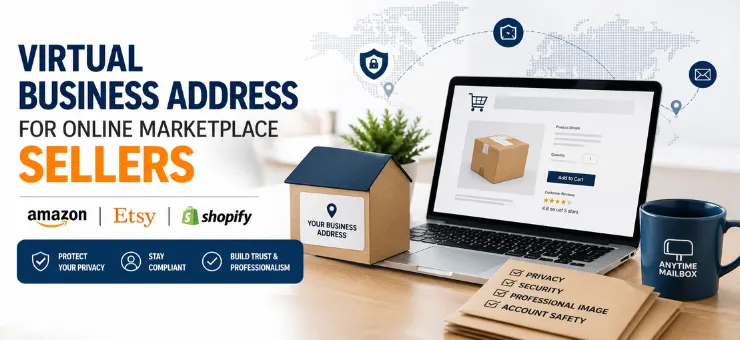
At first glance, it may seem that selling online is just a matter of listing your products, fulfilling orders, and waiting for customers to buy. However, as soon as you sign up as a seller with your first marketplace account (such as Amazon, Etsy, or Shopify), it quickly becomes clear that there are many layers of activities taking place behind the scenes as well.
Marketplace platforms require sellers to provide various business-related information, including their physical address, to ensure sellers are legitimate and reduce the risk of fraud. This is one factor that makes online marketplaces appear fairly safe for consumers to use.
The problem is that the address you give to internet retailers doesn’t always remain private. On some platforms, sections of your seller information may show up on invoices, seller profiles, and compliance documents.
If you’re a seller and likely a small business or a side hustle from home, using your home address can create privacy issues.
So, this is where using a virtual business address can become an answer to that problem.
Address Visibility on Marketplaces
After submitting a valid business address to a marketplace, many new sellers consider it to be private information. However, this is not necessarily true.
Many marketplaces utilize business addresses in various ways (depending upon the platform). As mentioned below, you will likely find your business address in several different locations.
- Seller Profiles
- Order Invoices
- Return Addresses
- Compliance Verification Records
- Customer Support Documents
Amazon is an example of a marketplace that requires sellers to provide a business address during account registration. An Amazon seller’s business address may also be included on an order document for transparency’s sake.
Etsy sellers must comply with local regulations when displaying seller details (including addresses) in their shop policies or on order receipts. In addition, if a seller operates a business from home, they likely wish to keep their home address private.
Although Shopify allows its merchants (store owners) to control what appears on their storefronts, each merchant must still provide a valid address for payment processing, taxation, and shipping. If you operate a home-based business, having your home address publicly listed could be very uncomfortable.
Privacy Considerations
Many businesses today operate home-based stores online. Many Etsy, Shopify, or Amazon sellers started their businesses in a spare bedroom at home or at a kitchen table.
There are many concerns that arise when you use your home address for your marketplace accounts.
No Privacy
Your customer will see your home address printed on invoices and in the seller information of the product they purchased.
Increased Security Risks
The public nature of your personal address increases the likelihood that people will contact you or argue with you at your home.
Professional Business Address
A residential address may not present the same image as a business address.
Using a virtual business address lets you keep your personal life and business separate. Instead of using your home address, you will be leasing a professional mailing address with a virtual address provider that maintains your privacy but still meets the requirements that you need to satisfy in order to use these platforms.
If you are interested in understanding how this works across various selling platforms, check out the Anytime Mailbox E-commerce Business Address Guide, which provides guidance on choosing the best address format for your business.
Platform-Specific Best Practices
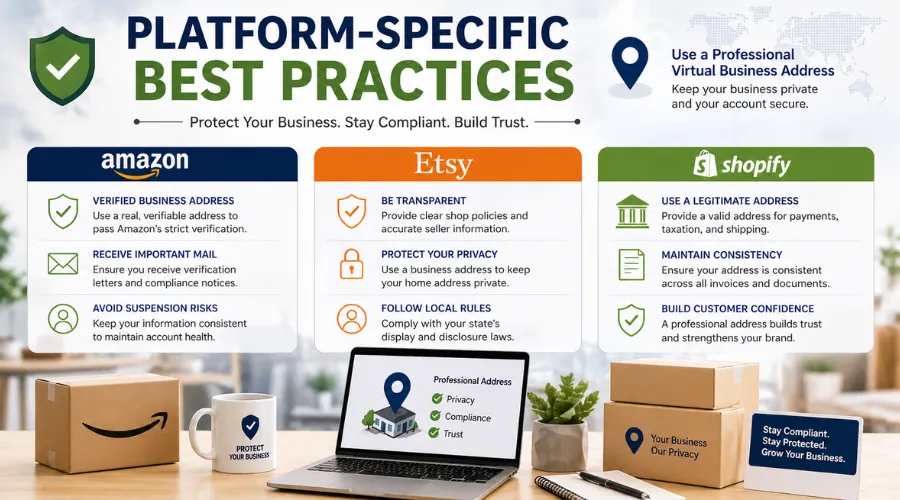
To comply with the different verification expectations of each marketplace and maintain sellers’ privacy, it is important to understand all verification requirements.
Amazon sellers
Amazon has very stringent requirements for verifying a seller’s identity, requiring sellers to provide a real, verifiable business address.
Using a temporary or unverified address may trigger additional verification checks. For this reason, experienced sellers tend to prefer a professional mailing address for receiving official correspondence and verification letters from Amazon.
Etsy shop owners
Etsy places great value on transparency in the eyes of buyers. As such, depending on your state’s regulations, a seller’s contact information may be displayed to a potential buyer in the seller’s shop information or in documentation sent to customers by Etsy.
Using a dedicated business mailing address allows Etsy sellers to be both professional and transparent while still protecting their home address.
Shopify Store Owners
Shopify has provided merchants with more control than any other e-commerce platform. However, when using payment processors and tax systems, sellers must still provide legitimate business addresses.
Using a professional mailing address ensures consistency of the seller’s information across invoices, shipping labels, and all customer communications.
Avoiding Suspension Risks
Account suspension is a leading concern for marketplace sellers due to fraud-prevention measures implemented by various platforms (such as Amazon). Problems with address verification are common and can occur when there are inconsistencies between what’s on file with the platform or when a mismatch arises during a seller’s review process. A majority of sellers will experience suspension-related issues if any of the following occur:
The seller’s address cannot be verified:
- Multiple sellers share the same address but list conflicting account names.
- The seller does not respond to platform emails at this address.
- Compliance notices are sent out, but not received.
The seller uses a stable, verifiable mailing address, thereby lowering their risk of suspension and increasing their chances of receiving important notifications, verification letters, and compliance documents at that address.
Reviewing a Compliance Checklist will help you identify minor issues in your current setup that could lead to bigger problems and account suspension.
How to Keep Your Seller Identity Safe
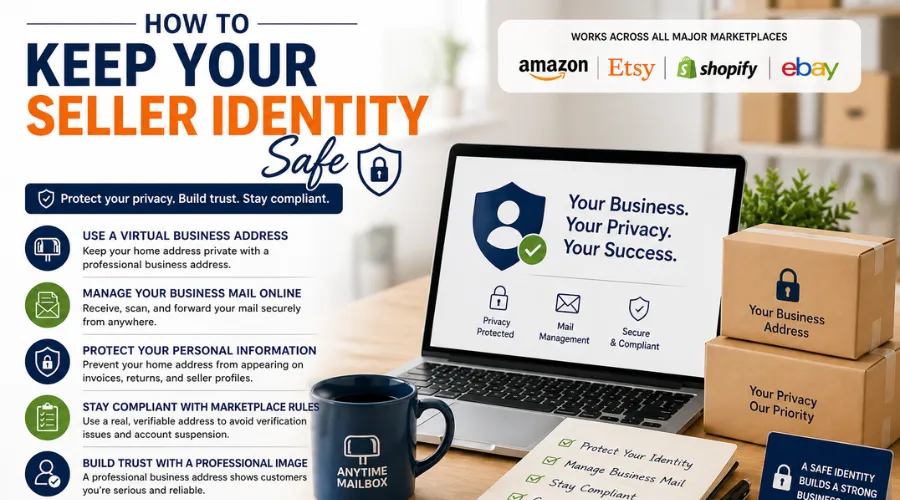
Being an online merchant means keeping track of your orders, answering customer questions, and listing your products for sale, but managing who can see your address shouldn’t be another source of stress. Many sellers who use marketplaces like eBay or Amazon have greatly benefited from using a virtual mailbox to separate their business life from their personal life. By using a separate address for receiving, scanning, and forwarding your business correspondence via the internet rather than your home address, you can create a professional appearance for your seller identification. Additionally, having a single address that can be used across multiple platforms, including Amazon, Etsy, and Shopify, provides a layer of privacy protection and helps you keep your seller identity organized. If you wish to simplify managing your business mail while remaining compliant with marketplace regulations, you may want to consider using a virtual mailbox service like Anytime Mailbox to store your important documents and keep them readily available when you need them.
FAQs
Q1. What is an online marketplace seller’s virtual business address?
The virtual business address refers to the physical mailing address a third party provides. Sellers can use their virtual business address instead of their home address. They can use their virtual business address for verification, shipping, or compliance with marketplace requirements while maintaining their privacy.
Q2. Why do Amazon, Etsy, and Shopify have a seller-business address?
Essentially, all marketplaces will ask for a stated business address because they must verify the seller’s identity to prevent fraud and ensure full transparency between customers and sellers. The address the seller provides will appear on invoices, return labels, or seller profiles (view our seller-business address policy).
3. Will my residence be disclosed to buyers?
Yes, depending on which site you are selling on, your residence could be printed on your invoices, envelope labels, or seller info pages for the customer to see.
4. What ways are there to make my privacy and security better with a virtual business address?
Providing a virtual address keeps your residence secret, reducing the risk of uninvited visitors or disputes about your residence. You are also keeping your personal and company communications separate, making your operations safer and more organized.
5. Will using a virtual address protect my account from being suspended?
Yes. A reliable and verified virtual address creates consistency across your documents and communications, reducing the risk of verification issues or of missing compliance notification letters that could affect your account status due to a discrepancy between your residence and what you have provided.